Healthcare website development in the medical device sector operates under strict regulatory requirements. Every claim, image, disclaimer and downloadable asset must pass medical, legal and regulatory review, carry the correct approval codes and reflect the appropriate market. Content that is compliant in one region may not be compliant in another, which creates significant complexity across the Johnson & Johnson Vision websites in Australia and New Zealand: Clear Vision For You for patients and JJV Vision Pro for professionals.
Case study · Health & wellbeing
Johnson & Johnson Vision: delivering compliant digital experiences in ANZ.
Two different properties, a patient education hub and a product website for eye care professionals, published by AMO Australia Pty Ltd in one of the most tightly governed content environments there is. We are the ongoing digital partner for both.
- Sector
- Health & wellbeing
- Service
- Website support
- Channels
- SEO
Website supportContinuous improvement

The challenge
What needed to change.
The patient hub had several compliance issues, including footer links directing users to a US healthcare professional website, social media links appearing in restricted areas, and Australian and New Zealand privacy policies published against the wrong markets.
The Vision Pro website needed an ANZ version built from an existing European website. Product ranges, ordering information, disclaimers, references and approval codes all differed between regions, so content had to be localised and unavailable products removed.
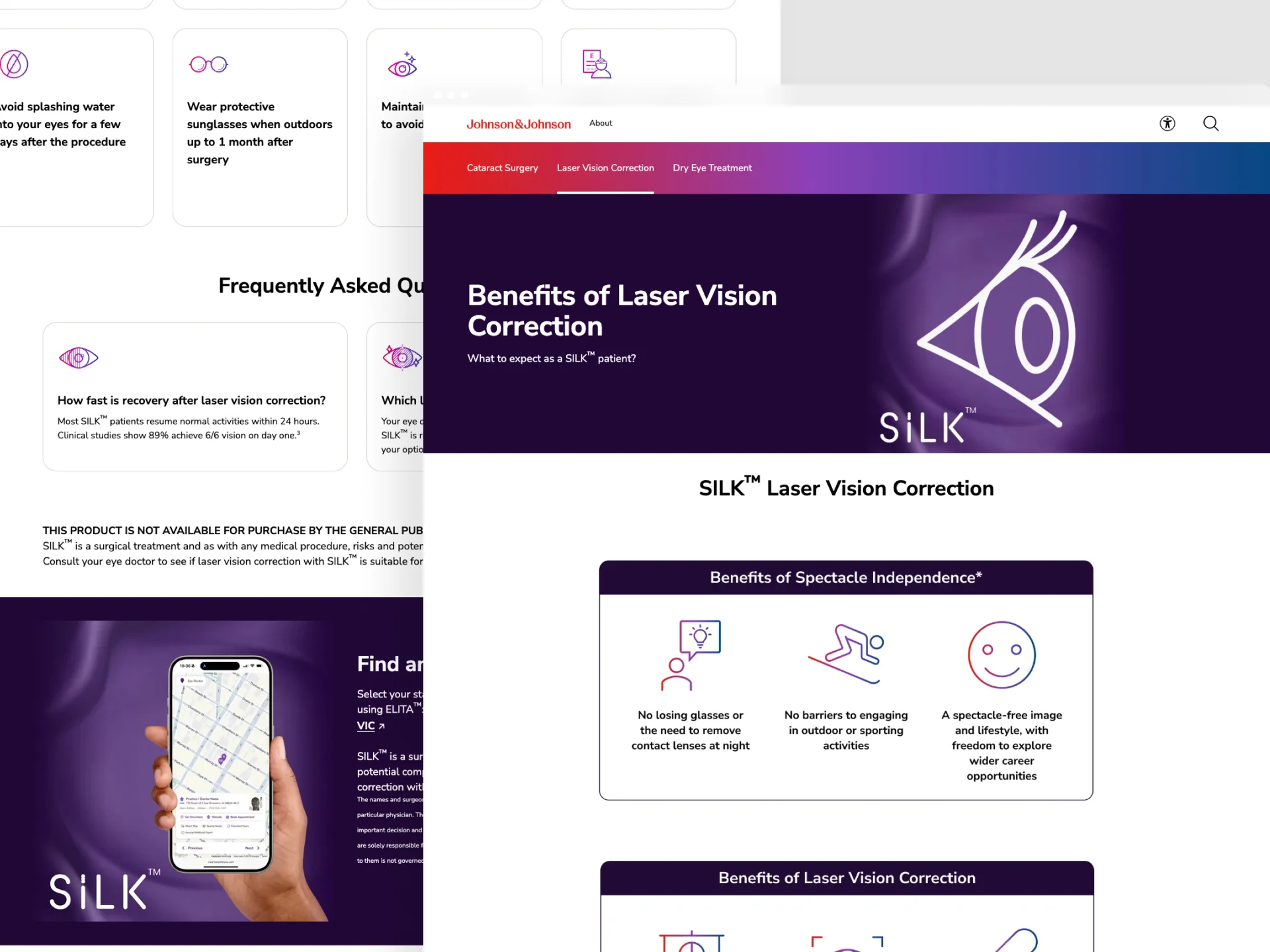
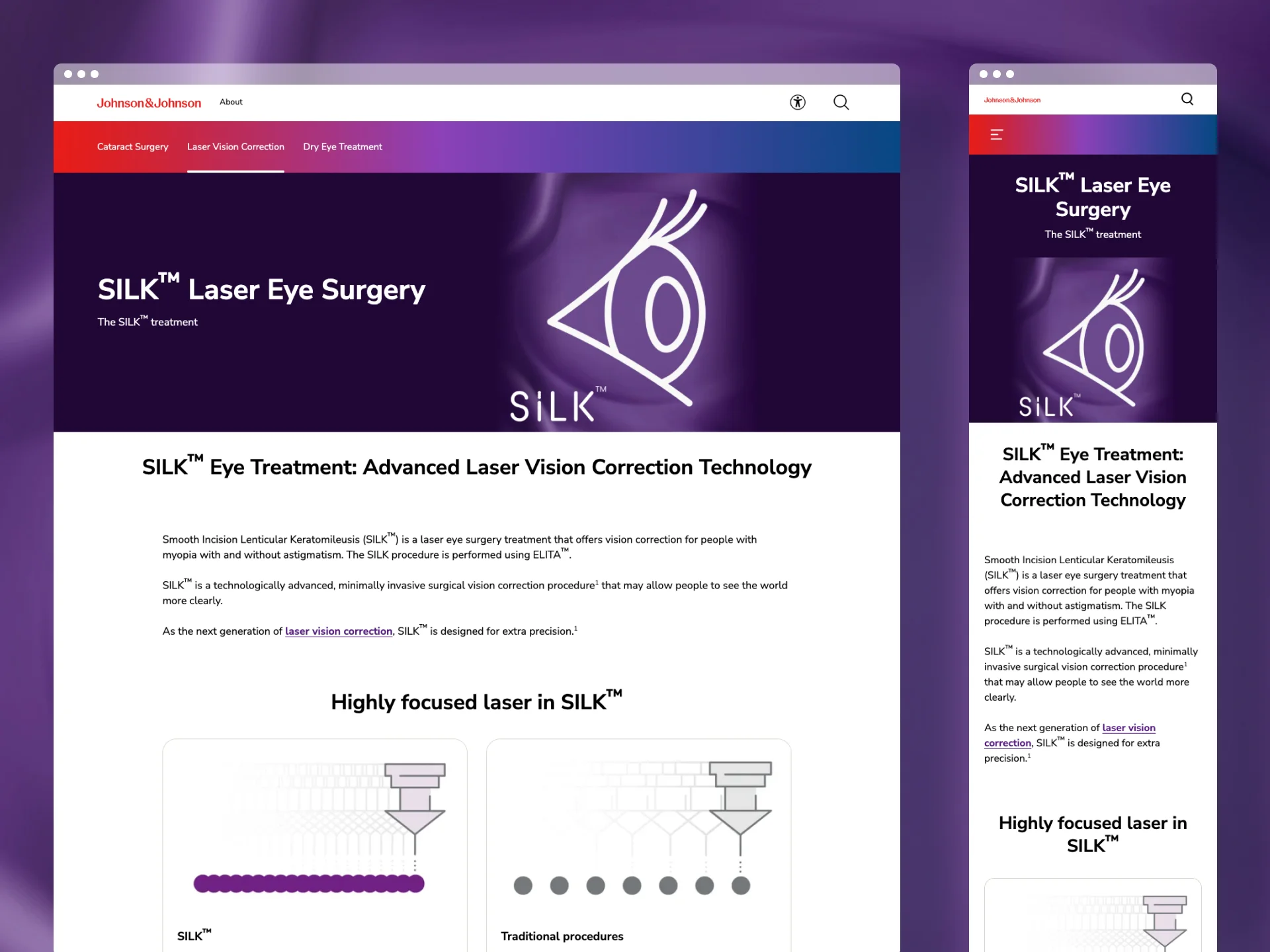
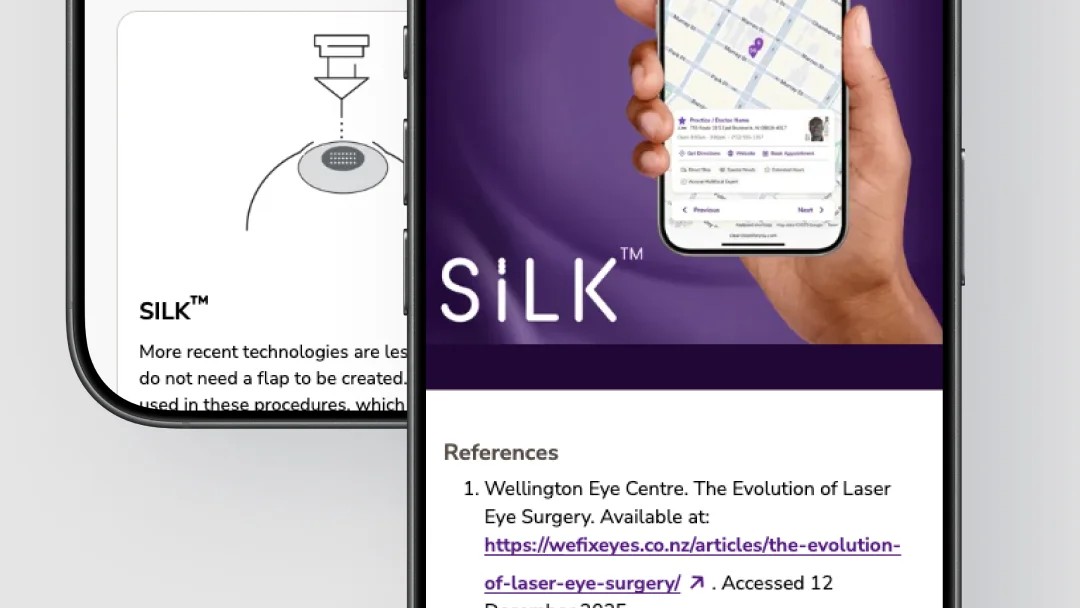
Alongside this, the SILK laser vision correction content lacked organic visibility. URLs, metadata, heading structure, image alt text and schema all needed optimisation, but every SEO recommendation also had to meet strict regulatory and brand approval requirements.
Approach
How the work took shape.
We structured the engagement around three parallel streams: regulatory remediation, market build and localisation, and SEO uplift. All three run through a shared ticketed workflow that takes each task from backlog and estimating through build, QA, client review and approval, so nothing reaches a live page without the right sign off.
Regulatory remediation came first. We removed non-compliant content, corrected footer links, privacy policies and sponsor information, and updated navigation while the revised content progressed through Veeva approval.
For the ANZ Vision Pro build we chose Contentstack, giving the team a headless platform that supports multiple locales from a single content model. That decision meant the European instance could be the starting point rather than the template, with product ranges, ordering, wording, disclaimers and approval numbers localised for the region and options for gating professional-only content assessed as part of the build.
SEO optimisation focused on five SILK laser vision correction pages, with every recommendation checked against regulatory compliance before it was made. A new Hub Page was also recommended to support future educational content and strengthen internal linking.
The shift
In a regulated environment, speed comes from a workflow everyone can see, not from skipping the review.
Talk to us
Need this kind of support behind your website? Talk it through with us.
Tell us what your project needs to do, and we will help identify the next step.
The work
The work, up close.
The Vision Pro ANZ build covered the home page, product listing and product detail pages for TECNIS Eyhance, TECNIS PureSee, TECNIS Odyssey, HEALON GV PRO and BAERVELDT Glaucoma Implants, along with contact, terms of use and privacy pages. The interactive Vision Simulator was carried across from the European instance and rebuilt for ANZ with a localised lens list, revised ordering, market-specific wording, disclaimers and approval numbers.
On the SILK pages, URLs, metadata, heading structure, internal linking, image alt text, schema and keyword-targeted content were improved inside the approval process. Downloadable assets were kept current, with patient information leaflets, sales aids and patient selection guides updated to approved versions and correct sponsor addresses as new documents were released.
The patient hub is now aligned to Australian and New Zealand compliance expectations, with the market-specific errors resolved and a clear process for taking content down, updating it and republishing once approval is granted. The Vision Pro ANZ website gives eye care professionals a localised product experience, including an interactive vision simulator built around the products actually available in the region.
The SILK content has been restructured around how patients search for laser vision correction, with the technical SEO foundations, metadata, headings and schema in place to support organic visibility and a content pathway mapped out for continued growth.
Johnson & Johnson Vision now has a clearly separated patient and professional digital presence in ANZ, with content that reflects local regulatory requirements rather than settings inherited from other markets. Comparison content, references and disclaimers all sit where the local reviewers expect them.
Just as importantly, the ANZ team has a delivery rhythm that suits a regulated environment. A shared, transparent workflow with defined QA and client approval stages means updates move at pace while still respecting the review cycle, and the partnership continues to evolve across both platforms.
Keep reading
Related work.
 Suzuki Motorcycles
Five years of website support keeping a national dealer network online every day.
Read more →
 MHFA Shop
Four years of website support keeping a national training provider's shop running.
Read more →
 Nostra Homes
Ongoing website support with every post launch issue resolved within two weeks.
Read more →