Embella sells online in a crowded category. Bespoke jewellery and a curated edit of fashion and beauty brands give the business a broad range to promote, but also a broad field of competitors bidding for the same searches and the same feeds. The brand wanted to lift its conversion rate and grow online purchases, and it wanted to do so in new markets where it was not yet known.
Case study · Retail & food
Embella: award-winning digital marketing for jewellery.
Embella Jewellery is home to an extensive bespoke jewellery collection and a curated range of fashion and beauty brands. Our social and search campaigns for the brand went on to win a dotCOMM award for Best Performing Social Media Campaign.
- Sector
- Retail & food
- Service
- Social media advertising
- Channels
- Google Ads
Digital marketingCampaign delivery
The challenge
What needed to change.
Reaching new users meant more than putting the same ads in front of more people. Audiences in new markets had to be understood before creative could be optimised for them, and the brand needed awareness before it could expect sales.
On search, competitors were ranking above Embella for the products it sells, so the Google Ads account had to be sharpened to compete on exact terms rather than broad ones. The measure of success was always going to be return on ad spend rather than reach alone, because a jewellery retailer cannot afford awareness that never turns into an order.

Approach
How the work took shape.
We analysed the market and competitors, then developed a marketing strategy for Embella. Entering new markets, we performed A/B testing in the initial stages to understand the audience, which made a meaningful difference to performance.
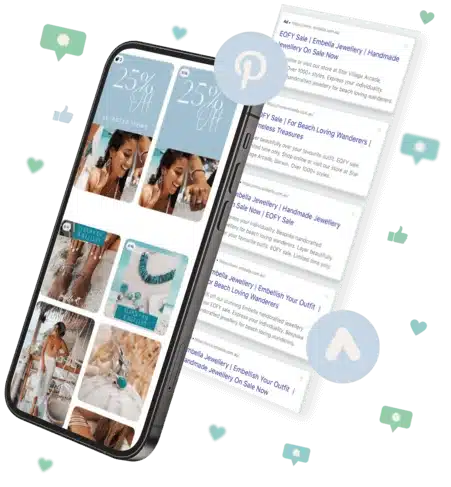
The first campaign was brand awareness aimed at new users, followed by a catalogue for dynamic product ads so that the right pieces reached the right people. Pinterest ads built brand awareness and increased the number of pins.
For Google Ads we used exact keywords for the products Embella sells and optimised them on performance. Keyword bids were adjusted to beat competitors and rank above them, and search terms were continually improved through competitor analysis. Google Smart Campaigns were used to optimise ads for online purchase conversions.
Across both channels the discipline was the same: test early, keep what works, and let performance data rather than assumption decide where the budget goes. That is what allowed the seasonal campaigns to be scaled with confidence when Black Friday and Easter came around.
The shift
Understanding a new market before selling into it is what turned awareness spend into purchases.
Talk to us
Planning social advertising like this? Talk it through with us.
Tell us what your project needs to do, and we will help identify the next step.
The work
The work, up close.
The social campaigns paired engaging design with content that gave people a reason to click, and the numbers followed: 9k post engagements at a click through rate of 3.55%. More importantly for a retailer, the return on ad spend held up over the long run, not just in a single burst.
14.24x.
Return on ad spend over a 15 month period.
26.93x.
Return on ad spend in one Black Friday campaign.
The Easter campaign showed the same pattern outside the biggest retail event of the year. With audiences already warmed by the awareness work and the catalogue ads doing the selling, a seasonal push converted at a rate most retailers would be pleased to see once.
The work was recognised with a dotCOMM award for Best Performing Social Media Campaign, but the award is the by-product. The result Embella feels is a conversion rate that kept rising across social and search, and a return on ad spend that justified every campaign that followed.
17.01x.
Return on ad spend in the Easter campaign.
Keep reading
Related work.
 Cosmic Polish
Meta advertising rebuilt around moving creative for an eCommerce nail polish brand.
Read more →
 Milone’s Tree Solutions
Local SEO that lifted organic traffic 450% and tripled ranked keywords in a year.
Read more →
+450% organic traffic, over twelve months.
 Boniik
Lifecycle email marketing rebuilt to scale revenue for a K-beauty eCommerce retailer.
Read more →